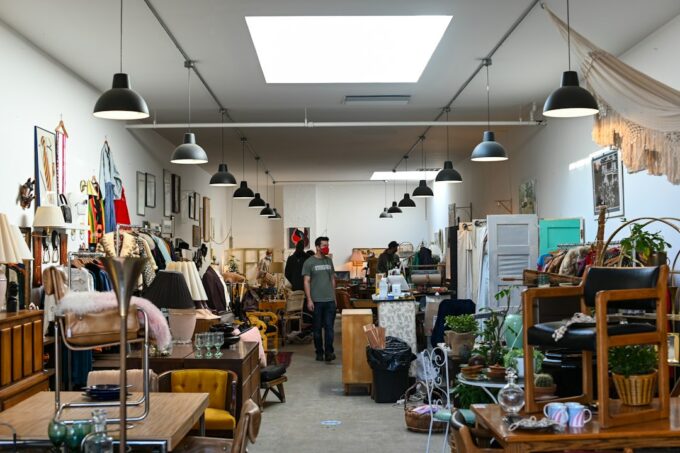



Maximalist interiors begin not with an instruction manual or a shopping list, but with the quiet accumulation of a life lived in full view. There is an early morning quality to rooms heavy with objects, where the light hits three different generations of framed watercolours, a stack of paperbacks bought from an independent bookshop, and a ceramic bowl filled with stones collected on a windy coast. We have spent decades being told that our spaces need editing, that peace lives in the empty corners and the blank white wall. Yet there is a fundamental human pull toward holding onto things, toward surrounding ourselves with the tactile evidence of where we have been and what we have loved. This is the starting point for maximalist interiors, a design language built through careful layering, saturated colour, accumulated collections, and personal history rather than simple, thoughtless clutter.
When we look back at the history of domestic spaces, as documented by institutions like the V&A, the British home has rarely been a temple of austerity. Historically, interior design has often favoured abundance, pattern, and the display of worldly curiosity over sterile minimalism (V&A, 2023). The difference between a room that feels rich and one that merely feels stuffed lies entirely in intention. Visual overload happens when items are purchased en masse to fill a void, resulting in a space that feels like a showroom or a warehouse. Intentional abundance, by contrast, is cultivated over time. It relies on the deliberate juxtaposition of textures, the grounding weight of wood and velvet, and the confident mixing of eras and epochs.
The Architecture of Layering and Personal History

Building a room through layers requires a certain kind of patience that cannot be bought in a single afternoon. It means allowing a space to evolve alongside your own tastes, keeping pieces that tell a story even if they do not match the prevailing mood of the moment. According to the Museum of the Home, domestic environments serve as archives of social change and personal identity, reflecting how we negotiate our private worlds against the backdrop of changing economic and architectural realities (Museum of the Home, 2022). In a rented flat with magnolia walls or a compact Victorian terrace, maximalist interiors adapt by scaling their ambitions, turning vertical space into galleries and using textiles to soften the rigid boundaries of modern housing stock.
Colour plays a vital role in this orchestration, shifting a room from a collection of isolated objects into a cohesive, enveloping landscape. Choosing a palette for maximalist interiors often means letting go of the fear that dark walls will shrink a room or that clashing patterns will induce a headache. When handled with an instinctive eye, contrasting hues create depth and shadow, drawing the eye across the room rather than trapping it in a single corner. Think of the way historical British interiors balanced botanical wallpapers with heavy drapery and mismatched upholstery. RIBA notes that spatial perception is heavily influenced by how we treat our interior surfaces and thresholds, proving that small rooms can handle intense visual stimulation just as well as grand country houses if the scale of the pattern is respected (RIBA, 2021).
Ultimately, having too much of everything is a celebration of memory and tactile pleasure. It is an antidote to the disposable aesthetics that have dominated the high street for too long. By embracing maximalist interiors, we give ourselves permission to live out loud, surrounded by the books we have actually read, the art that stopped us in our tracks, and the memories we refuse to pack away in a box under the bed. It is a home that asks nothing of its visitors except that they look closely, stay awhile, and notice the details.
References:
Museum of the Home, 2022. Domestic Evolution and Identity in British Interiors. London: Museum of the Home Press.
RIBA, 2021. Spatial Perception and Surface Treatment in Domestic Architecture. London: Royal Institute of British Architects.
V&A, 2023. Decorative Arts, Material Culture and the English Domestic Interior. London: Victoria and Albert Museum.