

British landscape painting has rarely been a simple exercise in passive observation; instead, it operates as a contested ideological space where national identity, ecological anxiety, and industrial ambition are constantly renegotiated. For centuries, our visual culture has relied on the comforting myth of a pastoral sanctuary, a green and pleasant land untouched by the friction of modern existence. Yet this genre has always harboured a darker, more complex impulse beneath its varnished surfaces. When we look past the academy conventions of the eighteenth and nineteenth centuries, we find a medium deeply entangled with land ownership, agricultural displacement, and the brutal realities of industrial extraction (Tate, 2023). Today, contemporary practitioners inherit this heavy historical baggage, weaponising and subverting traditional techniques to address modern crises of climate collapse, post-industrial dereliction, and contested rural access.
The Romantic Fabrication of the Pastoral Ideal

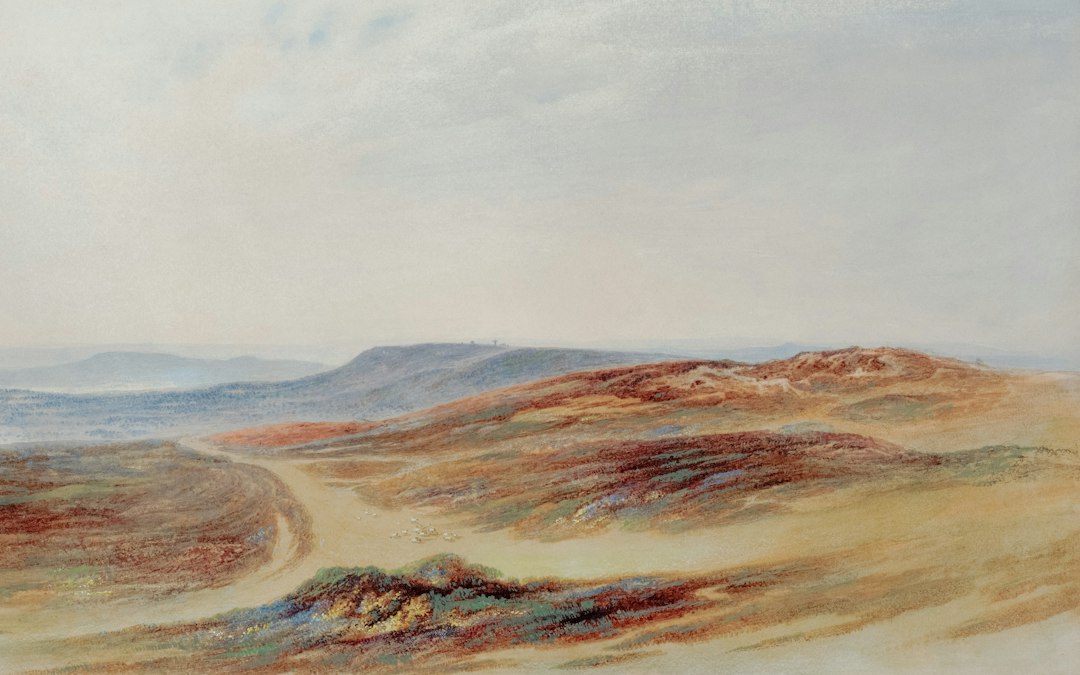
The institutional codification of our scenery during the Georgian and Victorian eras established a visual vocabulary that still haunts the national imagination. Painters like John Constable and Thomas Gainsborough did not merely record topography; they constructed a domesticated vision of the countryside that served the interests of the landed gentry. This pastoral construct deliberately erased the agricultural labourer, the enclosure acts, and the rural poverty that actually defined the rural economy. In these historical canvases, the earth is yielding, orderly, and morally redemptive, providing a quiet backdrop for moral philosophy and elite ownership. According to institutional archives, these foundational works helped cement a singular idea of heritage that equated virtue with an idealized, manicured nature (National Gallery, 2022). It is precisely this frictionless narrative that modern painters find themselves obliged to dismantle, recognising that our relationship with the earth is fraught with ecological violence and systemic inequality.
Industry, Extraction, and the Subversion of the Sublime
As the industrial revolution scarred the countryside, the artistic response fractured, giving rise to an uneasy tension between the picturesque and the mechanised. Painters could no longer pretend that the horizon was an untouched wilderness when the valleys were choked with soot and carved up by the railways. The sublime shifted from the awe-inspiring mountain peak to the terrifying efficiency of the blast furnace and the coal mine. This historical pivot reminds us that culture does not exist in a vacuum, much in the same way that British identity is constantly reshaped by industrial shifts and economic pressures. Artists began to record the landscape not as an eternal sanctuary, but as a site of intense human intervention and resource extraction. The earth became a workplace rather than a muse, forcing a reckoning that anticipated our current environmental anxieties by more than a century.
Contemporary Interventions in a Contested Terrain
Modern visual artists approach the terrain with a radical skepticism inherited from twentieth-century abstraction and conceptual art. Rather than seeking out picturesque vistas, contemporary practitioners focus on wastelands, monocultural farming, suburban sprawl, and the invisible borders of private estates. They investigate how public access to the countryside is heavily restricted, turning the canvas into a political document. This critical engagement parallels how communities preserve their intangible heritage, much like the folk music revival that rescues discarded oral histories from oblivion. By deploying unconventional materials—such as soil, tar, discarded plastics, and digital rendering—these painters refuse to offer the viewer visual comfort. They understand that to paint the environment today is to document an ongoing ecological emergency, stripping away the nostalgic lacquer that has obscured our ecological footprint for generations.
Four Critical Shifts in Modern Environmental Representation
- The rejection of the horizon line as a symbol of infinite possibility, replacing it with claustrophobic, flattened spaces that mirror ecological boundaries.
- The incorporation of toxic pigments and polluted water samples directly into the medium, literalizing the contamination of the biosphere.
- The shift from capturing permanent geographical features to recording rapid climate erosion, melting coastlines, and shifting agricultural zones.
- The interrogation of land rights, highlighting how historical enclosure acts continue to dictate contemporary spatial exclusion and class divisions.
The Persistent Urgency of Visualizing the Land
Ultimately, British landscape painting survives because it refuses to remain a static historical monument. By confronting the uncomfortable truths of our ecological and industrial history, contemporary makers ensure that the genre remains a vital arena for cultural critique. They remind us that the ground beneath our feet is not a neutral backdrop, but a dynamic archive of human ambition, failure, and resilience. As traditional craft continues to find new life in the hands of modern artisans, painters keep the dialogue between past trauma and future survival wide open. The canvas remains a mirror of our collective anxieties, demanding that we look closer at what we have built, what we have destroyed, and what we might yet salvage from the soil.
References
National Gallery. 2022. Landscapes of Power and Property in British Art. London: National Gallery Publications.
Tate. 2023. Defining the Nation: Essays on British Landscape Art and Industrialization. London: Tate Publishing.